
Waldstrolche Winnenden

3 Jahre bis Schuleintrittsalter, altersgemischt

Address
Waldstrolche Winnenden
Steinhäusle 45
71364 Winnenden
Funding authority
Waldstrolche Winnenden gUG
Steinhäusle 45
71364 Winnenden
info@waldstrolche-winnenden.de
https://waldstrolche-winnenden.de/
0151/62600028 (Frau Fides Podschun (Leitung))
Opening times8:00 AM - 2:30 PM o'clock
Closing daysOstern, Pfingsten, Sommer, Weihnachten, Brückentage, pädagogische Tage, max. 35 Tage pro Jahr
Foreign languages German
Denomination non-denominational
Specially educational concept child oriented education, Juul education, Emmi Pikler, project approach, Wood-Pedagogy
Extras Child care with special focus on environmental education

Current information

Introduction/specifics

Our forest kindergarten is located on the edge of the forest in the Schelmenholz district. Five fixed forest spots are available for our little forest explorers. Every day, we explore the forest for 4 to 4.5 hours. Depending on the location of the site and the number of exciting discoveries along the way, it takes 30 minutes to 60 minutes for us to get there.

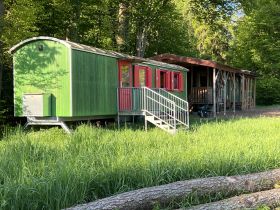
Two 12-meter-long mobile cabins not only provide shelter but also serve as the center of "future workshops," where many exciting projects are created. The mobile cabins are divided according to their functions. One cabin has been redesigned so that each child has its own locker and can independently and mostly without help access their change of clothes. There is also a wall with tools, allowing children to work with saws, screwdrivers, hammers, chisels, and much more, in consultation with the educators.

The second cabin invites children to stay and rest. It offers a cozy corner, a kitchenette with a stove, a reading nook, foldable tables for drawing, cutting, crafting, weaving, eating, and much more.

The cabins are heated with gas, so our little forest explorers can warm up and relax during colder or challenging weather conditions.

The cabins serve as drop-off and pick-up points. Especially in these times, the adjacent playground "Waiblinger Berg" is frequently used by our forest children.


Daily Schedule

Our day begins at our mobil cabins, where the children are brought between 8:00 and 8:30 a.m. During this time, they can paint, weave, craft inside the cabins or play and work on the playground outside.

Around 8:30 a.m., we gather in our discussion circle. Here, we decide together which spot in the forest we will visit, depending on the weather. We talk about why we choose certain places and make a democratic decision.

After choosing the spot, we make a stop at either the "summer place" or the first stopping point towards the "climbing hill". There, we either review rules or clarify who is present and who is missing. The hike lasts between 30 and 60 minutes depending on the location and discoveries, and exciting discoveries often interrupt our walk.

Around 9:30 to 10:00 a.m., we arrive at our destination, and the children begin free play. They can observe animals and plants, invent role-playing games, run around, build, climb, jump, splash in mud, collect things, tell stories, listen, relax, or simply enjoy themselves.

If needed, tools like hammers, rubber mallets, saws, screwdrivers, files, rasps, carving knives, and more can be handed out for small projects.

At around 10:30 a.m., a cuckoo signal calls us for a shared snack break. The children have their food and a damp cloth in their backpacks. Before eating, we ask who needs to use the toilet, wash hands (either in the water line or with the cloth), and then sit in a circle.

The snack begins with a saying to appreciate nature and its fruits.

Around 11:00 a.m., there is a period for small projects or further free play.

At around 12:00 or 12:30 p.m., we slowly start heading back. By 1:00 p.m., we are back at our shelter, and until 2:30 p.m., children can be picked up. During this time, they can have a second snack (warm if they like), use materials from the shelter, rest, or visit the playground.

Care providers are responsible for all profile content. (State: 01/09/2025 06:58:23)

Basics

The foundation of our pedagogical work is

1. Forest pedagogy. Spending time in nature offers many benefits for our children:

  • Encounters in an unstructured environment with child-appropriate stimuli
  • Experiencing immediacy — being in the here and now
  • Experiencing resilience — learning about one's own limits
  • Freedom to explore the world according to one's own possibilities
  • Plenty of movement and time for free work (free play)
  • Space for diverse relationships between
    • People and people
    • People and animals
    • People and trees and plants
    • People and objects, places, scents, silence, and soundscapes
  • Expanding one's ability to act in an unprepared environment
  • Appreciation for nature and the environment
  • Strengthening the immune system

2. Our pedagogical approaches

  • Child-centered, democratic approach: Children are perceived in their uniqueness and shape daily life according to their personality and individuality. The opinions of children are important to us; they are taken seriously and acknowledged. This leads to individual negotiation processes, fostering a close bond between children and educators. Children learn to take responsibility for themselves and to care for others.Through shared exchange, they begin to reflect on their actions and try out new behavior patterns. In the democratic approach, projects are planned together with the children. The "Future Workshop" by Robert Jungk helps transition from imagination to reality.

  • Experiential learning approach (Gerd Schäfer):
    Every day, we see how social, competent, active, and creative children are, and how eager they are to acquire knowledge about the world, culture, and nature. With a curious explorer's spirit and a wealth of ideas, they explore their environment with all their senses and gather experiences. These experiences form the basis for new explorations and insights. All children's efforts and activities are self-educational processes.

  • Approach of equal worth (Jesper Juul):
    This approach strengthens children's self-confidence and self-esteem and promotes social skills. It is based on four principles: the principle of equal dignity, the principle of valuing one's own identity, the principle of authenticity, and the principle of responsibility.

  • Principle of equal dignity:
    Children are naturally open and bring everything that makes them who they are into daily life.
    As equal partners, their needs, wishes, and feelings are taken seriously and acknowledged.

  • Integrity:
    Especially in developing the self, it is important to value children's values and beliefs and to support them through non-violent communication (Marshall Rosenberg).

  • Authenticity:
    Children are authentic and need authentic partners.
    Through our pedagogical attitude and non-violent communication, everything remains unjudged and allowed to be.
    All thoughts and feelings are openly expressed.

  • Responsibility:
    Children make their own decisions and also bear responsibility for these decisions.
    Educators accompany these decisions and the consequences that arise from them.

Teamwork with parents

  1. Familiarization Period

    The first separation from parental care presents a significant challenge for all involved. Therefore, the phase of the familiarization period is determined individually—according to the needs of the child and the parents. When the educators recognize that they can emotionally connect with the child, meaning they can comfort them, it indicates that the child has gained trust. The familiarization phase is considered complete.

    If parents are unable to commit to a longer familiarization period, the educators will work together with the parents to find the best possible approach for the child.
     
  2. Collaboration with Parents and Legal Guardians

    For our educational work, the involvement of parents and custodians of great importance. Therefore, we place a high value on an equal, cooperative, and partnership-based relationship with parents and guardians

    1. Communication channels

      We inform parents and custodians regularly through the following methods:

      1. Trial days (for interested parties)
      2. Information meetings at/on the mobile unit (observations)
      3. Information letters (also via email)
      4. Notices posted on the mobile unit
      5. Newsletter (monthly)
      6. Parent evenings (two per year)
      7. Development discussions (shortly after the children’s birthdays)
      8. Drop-in conversations at the door
      9. Individual meetings (by appointment)
      10. Phone calls
         
    2. Participation

      1. Our pedagogy, in which children are perceived and get to know themselves anew every day, can only be realized with the support of the parents. That’s why we value honest and open communication, so that we can recognize and understand the child's feelings and needs.

      2. Parent Council
        According to § 5 of the Kindergarten Act of Baden-Württemberg, a parent council is elected from among the parents during the parent evening. This council acts, among other things, as a mediator between parents, educators, and the provider. It has at least one member and one deputy. The parent council supports and relieves the educators and the provider through its participation. Additionally, the parent council may, at its own discretion, finance special equipment for the forest kindergarten.

      3. Support with Activities

        Furthermore, the Forest rascals also need assistance with planning, organizing, and designing festivals, as well as with sales campaigns or other promotional activities carried out by the Forest rascals.

        Here, a total of 2 hours per month are allocated. Grandparents or friends of the family are also very welcome to help.

      4. Participation in Projects

        We very much hope that parents and custodians will take part in some projects. This can happen in many different ways and is not necessarily tied to working days. Project meetings often also take place on weekends or in the evenings.

Specifics

Play, Fun, Excitement,

WALDSTROLCHE WINNENDEN!

Every letter of our name represents our educational diversity.

W – "Wild" explorers: Internalize the soul of the forest in a childlike way – plants, animals, water, or stones:
        all elements and beings of nature teach our children without a pedagogical finger pointing!

A – Eyes open! The eye guides the child into its world.

L – Forest habitat – experience biological diversity throughout the year.

D – Thicket & Co. – get to know the inhabitants of the five forest layers (root layer, soil layer, herb layer,
       shrub layer, tree layer).

S – Strengthen self-efficacy.

T – Develop team spirit through joint actions.

R – Resilience – empower children.

O – Ears open! The world reaches us through the ear.

L – Feel joy of life.

C – Explore chemical and physical processes in an experiential way.

H – Craftsmanship – create objects with natural found items.

E – Empathy – recognize, understand, and empathize with emotions.


W – "Forest bathing" – everything for the soul.

I – Individual experiential learning.

N – Perceive elements of nature with all senses.

N – Encounter alienation from nature.

E – Deceleration.

N – Just be for yourself! – children also need a break.

D – Differentiations – experiences of sameness and separation.

E – Relaxation.

N – Recognize and deal with natural dangers.

Care providers are responsible for all profile content. (State: 01/09/2025 06:58:23)

Overview

Admission Criteria

  1. Children aged three years up to school entry age are admitted based on available places.
  2. Primarily, children from Winnenden and all districts of Winnenden are accepted. If there are still places available, children from surrounding towns can also be admitted.
  3. An observation visit by the parents/custodians is a prerequisite for admission.
  4. The Waldstrolche establish the principles for the admission of children to the forest kindergarten. There is no legal entitlement to the admission of a child.
  5. Each child must undergo a medical examination before being admitted to the Waldstrolche. Before the official admission of a child, the following documents must be available:
    1. Medical certificate of a medical examination;
    2. Proof of measles protection;
    3. Proof of vaccination consultation;
    4. Complete information about any other illnesses and, if applicable, a copy of relevant documents such as an allergy pass;
    5. Admission takes place after signing the care contract and providing all information listed in the registration documents.
Care providers are responsible for all profile content. (State: 01/09/2025 06:58:23)

Description and Stations

Public Transport from ZOB Winnenden
Bus Line 330, stop Theodor-Heuss-Platz
Walking path towards Grundschule Schelmenholz (450 m - about 6 minutes)

By Car


Take B14 from Stuttgart, exit Winnenden
Turn right onto Waiblinger Straße
Turn right onto L1140 - until the roundabout at Henry-Dujol-Kreis, take the first exit
Continue on Forststraße (290 m)
Turn right onto Steinhäusle, go straight to Grundschule Schelmenholz (550 m), there is parking available
Walking path to the playground Waiblinger Berg

Care providers are responsible for all profile content. (State: 01/09/2025 06:58:23)

Maps are displayed only if you accept the corresponding cookies.
enable map