Kita Wunderwald

Address
Kita Wunderwald
Hospitalstraße 25
28790 Schwanewede
Funding authority
Gemeinde Schwanewede
Damm 4
28790 Schwanewede
kita-wunderwald@schwanewede.de
https://www.schwanewede.de/wohnen/kinderbetreuung/kindertagesstaetten/
04209/ 9898346 (Frau Hartung)
Opening times7:00 AM - 4:00 PM o'clock
Closing daysCa. 20 im Jahr - 15 davon in der Sommerschließzeit
Specially educational concept child oriented education, daily routine language education, partially open concept, Situation orientated approach
Extras Barrier-free, care with lunch, full day care

Current information

Auf unserem Instagram-Account kita.wunderwald geben wir kleine Einblicke in unseren Alltag, teilen Spiel- und Bastelideen und zeigen die Wunder unserer Kita. 

Introduction/specifics

We offer various childcare hours. 

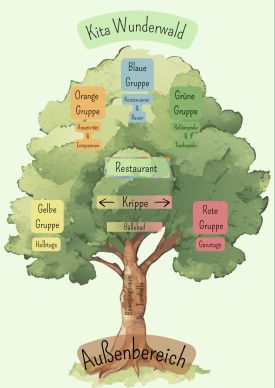
In the nursery, the Red Group is open from 7:30 a.m. to 3:30 p.m. and the Yellow Group from 8:00 a.m. to 1:00 p.m. For working parents, we offer half an hour of special opening hours before and after the core opening hours. 

In the elementary school, we offer childcare from 8:00 a.m. to 12:00 p.m., from 8:00 a.m. to 2:00 p.m., and from 7:30 a.m. to 3:30 p.m. For care until 2:00 p.m. and until 3:30 p.m., lunch is offered from 12:00 p.m. These two core times also include a half-hour of special opening hours for working parents.

Rooms

Nursery

The two nursery groups are directly opposite each other and connected by a large hallway, which is used as a play area. Various elements such as platforms, vehicles, and balls are provided here and adapted to the children's needs.

Both groups have their own washroom with a large changing table and their own bedroom. The children have their own compartments at the changing table and can use photos to find their own changing items. In the sleeping room, each child has their own bed with a picture frame designed by their parents hanging above it. Care is taken to create a cozy and pleasant atmosphere and to take individual sleeping needs into account.

There is also a differentiation room. This is regularly redesigned, but is mainly used as an exercise room, as it is where the large ball pit is set up. 

Both nursery rooms, like the groups in the elementary area, have access to the outdoor area. The nursery has its own area here, which is separated from the elementary area by a fence. The two areas can also be used together through a garden gate. 

Elementary area

The three groups in the elementary area are also connected to the large hallway, which is used as a play area. All group rooms have various materials such as building blocks, materials for creative design and role-playing games, and various educational and board games. In addition to its own washroom with a large changing table, each group room also has an adjoining room with different focuses. The adjoining room of the Blue Group is used as a building room, that of the Orange Group as a quiet room and library, and that of the Green Group as a role-playing room. Thanks to the partially open concept, all children can play in these rooms. They are regularly adapted to the wishes, interests, and needs of the children and redesigned together. 

In addition to the group rooms and adjoining rooms, there is a gym that can be used for various activities. This is also regularly equipped with various play and exercise options. The large hallway adjacent to the hall serves as a track for vehicles and can also be used for romping around. The children are allowed to be loud here. 

Meals are eaten in the restaurant. This is also used for preschool work with larger preschool groups, so that the children have a quiet, secluded space to learn. 

Special features

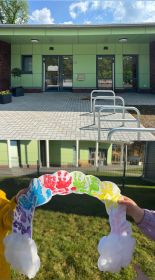
As the facility opened in April 2024, it is still new and modern. The walls are painted in soft colors, the floors are light, and large windows allow plenty of light into the rooms. High ceilings and wide corridors make the facility feel spacious and offer plenty of room for play and fun. 
When decorating, we make sure that the colors match and that the rooms do not appear too cluttered. The children should be able to find their mark in the facility and are allowed to actively participate in the decoration and design of the rooms. 
Thanks to the partially open concept combined with the playable hallways, the children in our facility have plenty of opportunities for movement and plenty of space to develop their needs. At the same time, all rooms offer sufficient opportunities for retreat, inviting children to snuggle up and withdraw.

All rooms are also on one level and there are wide doors, making the building inclusive.

Pictures of the premises can be found in the gallery.

Daily Schedule

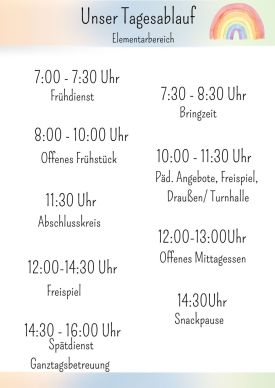
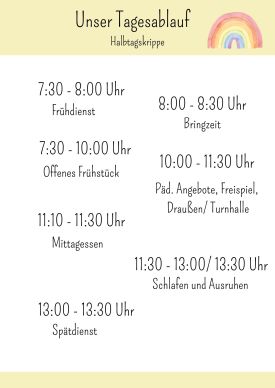
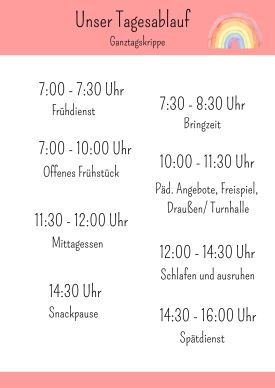
Our daily routine varies in terms of timing between the different groups. These provide a time frame for the children and staff, but can be changed flexibly.

Basically, we would like all children to arrive at the facility by 8:30 a.m. so that we can start the day together and plan activities. After drop-off time, the activity and free play phase begins, providing time and space for various guided activities and projects or for open play in the various rooms of the facility.
The partially open concept gives the children the opportunity to move around all the rooms of the facility and participate in various activities. The nursery and elementary school areas can also visit each other.

During and after lunch, which is explained in more detail in the “Meals” section, the nursery offers an afternoon nap in the sleeping room of the respective group, and the elementary area offers various opportunities for rest. In adjoining rooms, books are read aloud, dream journeys are taken, or Tonies are listened to. At the same time, free play takes place.

From 2:30 p.m., the late shift of the all-day care begins with a short snack break, during which the children eat a small snack such as fruit or vegetables together. The children from the nursery and the elementary school often spend the late shift together, as there are only a few children left and they enjoy playing together.

Food

Our facility is supplied by Catering Service Weiser. Families provide their own breakfast. We encourage healthy and balanced packed lunches so that children have sufficient energy and nutrients for the day. Of course, it is acceptable to have something special occasionally; a good balance is important to us. 

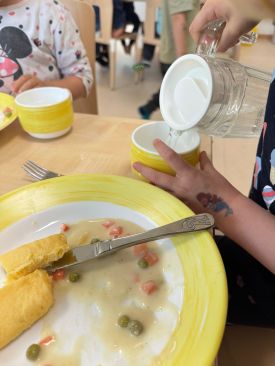
The two nursery groups eat in their group rooms. Breakfast is organized in an open manner so that the children can eat when they are hungry. Lunch is eaten together at a fixed time before the children have the opportunity to take a nap. The children are accompanied by the educational staff at every meal. They give them the opportunity to take their food and drink independently and support and accompany the children in doing so.

Meals in the elementary school are open. From 8:00 to 9:30 a.m., the restaurant is staffed by qualified personnel and children can have breakfast whenever they are hungry. Outside these hours, they can have breakfast in the group room at any time. At lunchtime, there is a fixed number of children who can eat at the same time. Therefore, each group has a number of meal cards that serve as “admission tickets” to the restaurant. When the children have finished eating, they return their cards to the group room themselves and ask who would like to eat. This gives the children the opportunity to follow their hunger cues and then go to lunch when they are hungry or when they want to go with their friends. During lunch, the children are accompanied by at least two staff members who encourage independence, create opportunities for conversation, and accompany and support the children. 

In order to keep track of whether and how much the children have eaten, there are various lists on which different things can be entered. This ensures that the group staff can provide feedback to parents about the meals.

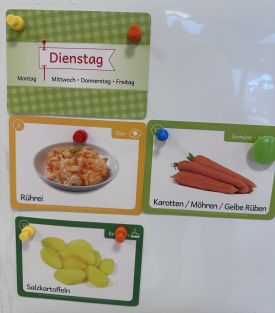
For both areas, the menu is displayed in the form of pictures so that the children can see what is available for lunch. 


Care providers are responsible for all profile content. (State: 27/01/2026 12:17:41)

Basics

Partially open concept

We work according to a partially open concept. This means that there are core groups with designated caregivers for the children, but at the same time the premises are open. The children can decide for themselves which room they want to be in and where and with which materials they want to play. Activities are offered in the various rooms for all children to participate in. 

To ensure a clear structure, there are certain group times. These are, for example, in the morning during drop-off time, so that the children can arrive at their group in peace. However, as the children choose their own caregivers, they always have the option of joining another group.

Together with the children, it was decided that Fridays would always be group days. On Thursdays, they decide as a group what they would like to do on Friday and spend the day together only with their regular group. Here, for example, they bake, do research, play movement games, or go on excursions. 

Our educational approach

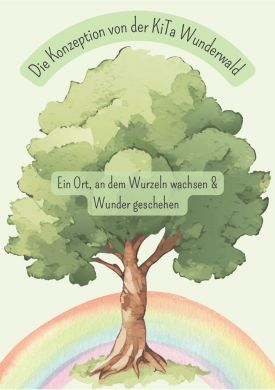
Our educational approach plays a crucial role in the children's development. At Wunderwald, we see every child as unique and valuable. With wonder, curiosity, and trust, we accompany the children on their individual paths—just as a tree in the forest does, giving each leaf its own place while offering protection, support, and space to grow. 

Our educational approach is characterized by mindfulness, appreciation, security, and a deep respect for the individuality of each child. We understand education as a holistic process that takes place in everyday life—in play, in discovery, in shared activities. At our center, children learn in a stimulating and safe learning environment with all their senses, at their own pace, and with great joy.

For us, the “Wunderwald” (magic forest) is more than just a name – it symbolizes our attitude. We create an environment in which children can put down roots, feel safe and secure, but also develop wings to explore the world. Our team accompanies them on this journey with professional competence, heart, and an open mind.

Employee

In the elementary section, there are two qualified staff members working in the Blue Group, two in the Orange Group, and three in the Green Group, who are supported by a trainee three days a week. One substitute staff member has her regular group in the Blue Group and another in the Orange Group. This means that all groups in the elementary section are fully staffed with three qualified staff members.

In the nursery, there are three qualified staff members in the Yellow Group and the same number in the Red Group. Two temporary staff members for the nursery support both groups and plan cross-group activities. In the nursery, the qualified staff share their hours so that there are always primary caregivers present, who are supported by additional hours from the other qualified staff. 

At Wunderwald, we place great importance on trusting and appreciative teamwork. Together, we create an atmosphere in which children, parents, and professionals alike feel comfortable. For us, teamwork means more than just completing tasks together. It is at the heart of our daily work and contributes significantly to the quality of our educational work.  The values and principles of our teamwork are based on appreciation, respect, and open communication. We work cooperatively, support each other, and take responsibility for the well-being of the children and the implementation of our educational concept. Through continuous reflection and further development, we ensure the quality of our work and always strive for improvement.  To ensure effective collaboration, we rely on clear structures and regular team and case discussions, in which we take the opportunity to reflect, plan, and develop further. This is supplemented by various methods in the area of communication and reflection, in which, for example, giving feedback, questions of attitude, and further developments are given space.

Quality Assurance

At Wunderwald, we see evaluation as a continuous, systematic process for ensuring and further developing educational quality. The aim is to continuously reflect on and optimize the quality of care, education, and upbringing. In doing so, we always focus on the well-being and development opportunities of the children. 

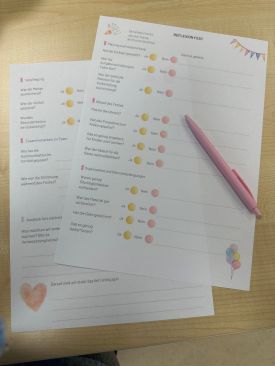
We use a variety of methods to carry out evaluations, taking into account both quantitative and qualitative aspects. These include everyday observations, reflective discussions within the team and with parents, children, and external specialists, feedback rounds and structured questionnaires, documentation of child development, and analyses of existing concepts and work processes.

We place particular emphasis on the participation of the children. We actively involve them in evaluation processes in an age-appropriate manner. This is made possible by observing their reactions, interests, and needs, through storytelling sessions and interviews with children, and by using symbol cards to express their opinions. Activities, offerings, and celebrations are reflected on together afterwards and recommendations for action are drawn from this. These participatory elements provide us with valuable insights into the quality of our work from the children's perspective and at the same time promote their co-determination and self-efficacy.

Cooperations

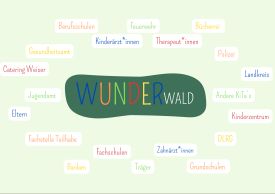
Social networking and cooperation, along with voluntary work, are central elements of our educational work. As part of the Schwanewede community, we have established a network with numerous individuals, institutions, associations, etc. in order to pool existing skills and resources and to jointly develop and offer targeted, effective, and efficient services for children and their families. We see ourselves as part of a supportive network for children and families. Our goal is to provide children with the best possible opportunities for development and education, as well as to comprehensively support and strengthen their families.

Our cooperation partners can vary and expand at any time. In doing so, we take into account our current services, seasons, developmental stages, and the interests and wishes of the children. If necessary, we arrange contacts with various support centers and assist families in accessing assistance services.

Teamwork with school

For the transition from daycare to school, known as the bridge year, we work according to the Berlin model. This program focuses on close cooperation between daycare and school in order to make the transition smooth for the children. Various visits to the school take place so that the children can get to know the teachers and the school. This includes, for example, joint Advent singing, visits to lessons, joint celebrations, mentoring rallies, and the school program “Hexe Mirola” (Witch Mirola), in which the children complete various tasks accompanied by their new teachers. Here, the preschoolers get to know their future school building, the teachers, and some of the routines through various activities.

All activities are planned and reviewed together with the teachers to ensure they are tailored to the children's needs.


Teamwork with parents

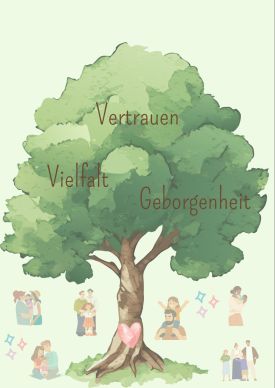
A tree grows from strong roots. At Wunderwald, families are the solid trunk that gives every child stability, love, and a sense of belonging. Trust, security, and diversity grow from this trunk.

Working together with families forms the basis for a trusting and appreciative relationship between parents and professionals. We regard parents and guardians as important caregivers for their children and as active partners in the educational process. Successful dialogue between the daycare center and the family is of great importance here. To this end, we maintain open, respectful, and transparent communication.

From the settling-in period to the transition to school, we actively involve families and create space for exchange and opportunities for participation. In addition to regular development and concern discussions, this also includes parents' evenings and joint celebrations and projects. Parents can also visit our facility to get a closer picture of the everyday life their children experience here with us.

Care providers are responsible for all profile content. (State: 27/01/2026 12:17:41)

Overview

Children who are registered as having their primary residence in the municipality of Schwanewede at the time of care are generally entitled to a place in childcare.

Children are accepted from the age of one until they start school.

  • Nursery: from the 1st birthday until the age of 3


  • Kindergarten: from the 3rd birthday until starting school

You can specify up to three daycare centres as your preferred facilities. These preferences will be taken into account within the limits of available capacity. Please note, however, that there is no entitlement to a place in a specific daycare centre or to specific childcare hours.

Further information can be found in our statutes on the establishment and use of daycare centres in the municipality of Schwanewede.

Care providers are responsible for all profile content. (State: 27/01/2026 12:17:41)

Maps are displayed only if you accept the corresponding cookies.
enable map