
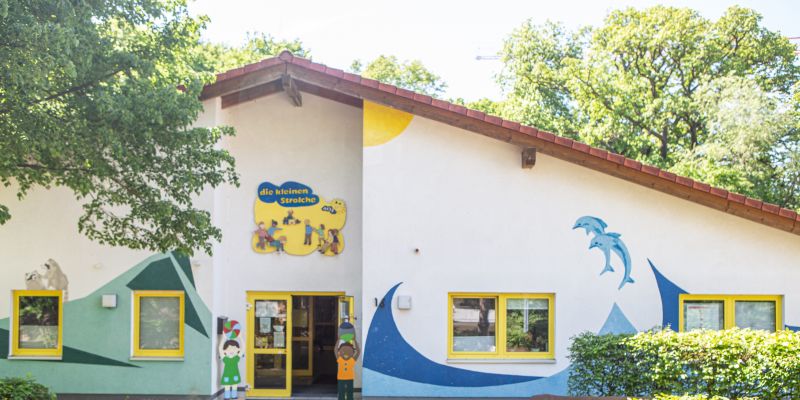
Kindertagesstätte „Die kleinen Strolche“

6 Monate bis 3 Jahre in der Krippe, 3 - 6 Jahre in der Kindertagesstätte.

Address
Kindertagesstätte „Die kleinen Strolche“
St.-Martin-Straße 16
35039 Marburg
Funding authority
Arbeitskreis Soziale Brennpunkte (AKSB)
Ginseldorfer Weg 50
35039 Marburg
kita-leitung@aksb-marburg.de
http://www.aksb-marburg.de/die-kita/
06421/6200161 (Linda Hermann- Leitung, Nadja Mann- Stellvertretung)
Opening times7:00 AM - 5:00 PM o'clock
early care7:00 AM - 8:00 AM o'clock
late care4:00 PM - 5:00 PM o'clock
Closing days3 Wochen in den Sommerferien (Wechsel: entweder die ersten drei Wochen oder die letzten drei).
Über Weihnachten und zwischen den Jahren.
Foreign languages Arabic, German, Polish, Russian, Turkish
Specially educational concept daily routine language education, inclusion, intercultural education, nature education, partially open concept, Situation orientated approach, Wood-Pedagogy
Extras Barrier-free, Pets, care with lunch, family counseling, language education
Pets Ja, Fische.

Introduction/specifics

The operator of the daycare center is Arbeitskreis Soziale Brennpunkte Marburg e.V. (AKSB).

The AKSB is a non-profit association that, together with local residents and partners from politics, administration, and other institutions and organizations, works to improve the living conditions and quality of life in the Waldtal district. It provides social services, promotes the participation of the district’s residents through empowerment and engagement initiatives, and advocates publicly for their concerns. In addition to the daycare center, the association also works in areas such as “Zusammen Wachsen” (Growing Together), the children’s house, social and debt counseling, family counseling, and neighborhood work.

In addition to its statutory mandate, the daycare center is committed to the principles of community work. It operates in a participatory, cooperative, community-focused, and life-world-oriented manner. Being integrated into the sponsor’s community work means that the daycare center not only caters to the needs of the children but also considers the concerns of the parents and the living conditions of families in the district. It is part of our core philosophy to support families in their parenting efforts and other issues, and to work towards improving the living conditions for children and families in the district.

A key aspect of this approach is the collaboration with the other departments of the sponsor. This allows parents to be quickly referred to the sponsor’s social and family counseling services when needed. In cooperation with the AKSB’s neighborhood work, we carry out initiatives to shape the local community. Additionally, we work together with the “Zusammen Wachsen” department and the “Kinderhaus” for 6- to 12-year-olds, particularly focusing on transitions and parental education.

In our facility, educational professionals work both full-time and part-time.

The various groups are supported, if needed, by two professional interns, a federal volunteer, additional interns, family mentors, and other volunteers.

The daycare center “Die kleinen Strolche” offers a total of 75 places. For children aged 3 to 6 years, there are 64 full-day places available, divided among four groups. Additionally, 10 places for children aged 6 months to 3 years are allocated to the nursery group, our “Küken.”


 

Rooms

The childcare center consists of six group rooms. The group rooms for the nursery group and the mother-child group “Zusammen-Wachsen” are located in the rear new building. The four daycare group rooms for the Waschbären, Delfin, Wolfs, and Füchse groups are attached to the front section of the facility. Inside the building, there is also a kitchen, visitor and staff restrooms, two offices (where the management and deputy, the language specialist, and the staff of “Zusammen-Wachsen” work), a staff room and a break room, a materials room, a cleaning supplies room, and a heating room.

Each group has an elevated platform that has been individually designed, for example as a spacious doll corner that invites role play. The children can change the function of these platforms on their own as often as they like.

The group rooms provide the children with space to interact with one another, play games, and express their creativity. At the same time, there are cozy corners and niches for napping and retreating to simply feel comfortable. Each group also features inviting reading corners where children can look at picture books or listen to a story.

Two additional rooms are integrated between the front group rooms:

  • The Children’s Library: This room houses our picture books on a wide variety of topics. It also serves as a space for language and learning sessions led by our language specialist, and it provides a quiet area for calm reading aloud.

  • The “Snoezel-/Play Room”: This room is equipped with foam cushions, pleasant lighting, and mats that invite relaxation. Additionally, children can quietly play board games at tables.

In addition to the group rooms, the facility has a large movement room. This room is equipped with everything you would expect in a gym hall—a balance beam, vaulting boxes, soft floor mats, soft balls, gymnastics balls, and much more. It is used to carry out larger movement and sports activities. Especially during the colder months, it provides space for running and roughhousing indoors.

Outdoor Facilities

The daycare center is surrounded by a large, natural outdoor area that the children can use as a space for exploration, experimentation, and play. This area features a small atrium, sandboxes, slides, plenty of trees for climbing, and elevated spots for running and hiding. In our raised garden bed, the children watch strawberries and herbs grow—and of course, sometimes they even get to taste them.

The varied interior design and outdoor area provide sensory and movement experiences that have a positive effect on language development, among other benefits. Additionally, this setup helps accommodate the children's need for physical activity.

Food

Free Breakfast

Children can decide if and when they want to have breakfast until 10:00 AM. It is important to us that children recognize their own feelings of hunger, perceive their bodies and needs, and thus develop healthy eating habits. Drinks such as tea and mineral water are available throughout the day. For health reasons, our daycare follows a sugar-free morning policy.

In the forest group, breakfast is eaten together on a picnic blanket after a handwashing ritual. Since the children walk a lot, they choose a suitable spot for breakfast. During the colder months, warm drinks are offered in addition to the packed breakfast. In cases of extreme weather conditions, breakfast takes place inside the kindergarten.

Shared Breakfast

Once a week, a shared breakfast takes place within the groups. The focus is on healthy eating. From a "robber’s breakfast" to fruit salad, the children or the kitchen prepare the breakfast independently. This promotes participation, independence, and communication while also helping the children acquire practical life skills and broaden their eating experiences.

Lunch Table

We provide a mandatory warm lunch for all children in our facility, freshly prepared daily by our cook. We prioritize organic foods that are typically sourced locally and in line with seasonal availability. The same applies to the daily afternoon snack.

Children have a say in the meal plan. Additionally, the kitchen staff considers the children’s dietary needs, including allergies, vegetarian preferences, and religious requirements. Meals are prepared both with and without meat from various animals, and special dietary laws (such as halal) are respected. Dishes from different cultures are also incorporated. This approach ensures that all religions, preferences, and beliefs are valued and respected.

Care providers are responsible for all profile content. (State: 21/04/2026 10:11:07)

Basics

What is important to us in our work with the children ...

  • to provide the children with a good basic care

  • to build a reliable relationship with them

  • to promote their healthy development

  • to take their cultural roots into account in our work

  • to foster a sense of community

  • to support their language development

  • to encourage the children to develop a joy for self-determined learning

  • to strengthen their abilities

  • to involve them in shaping the daycare routine and their environment

  • to complement family upbringing

For the families, we would like to ...

  • provide flexible childcare hours

  • offer close and trusting collaboration

  • provide support in their parenting efforts

  • be a point of contact for all their concerns

  • create opportunities for them to contribute their skills and participate

  • offer opportunities for neighborhood connections

Regarding our district, we would like to ...

  • keep an eye on the living situation of children and families in the district

  • address, discuss, and work on topics and needs arising in the district

  • participate in neighborhood activities

  • support the involvement of families in the social development of the district

  • be a meeting place for families and the community


Employee

To address the specific needs of the neighborhood, the groups for three- to six-year-olds are accompanied by two to three professionals. The nursery group is led by three professionals. The various groups are supported by professional interns, a federal volunteer, additional interns, family mentors, and other volunteers. All of these individuals have the opportunity to take on responsibilities within the group and can independently design projects.

Diversity and interculturality are integral parts of our educational work. In order to provide a point of contact for people in the neighborhood whose first language is not German, we also employ educators with a migration background. In addition, we employ both female and male professionals who equally carry out all tasks required by our educational mandate.

To ensure high-quality educational work, regular exchanges about content and topics, as well as organizational arrangements and preparations, are absolutely necessary. The professionals receive what is called "allocated time" during which they prepare and follow up on group activities, document developmental processes, conduct case discussions, and engage in outreach with parents. They meet weekly as a team for cross-group planning, coordination, and collegial consultation. In a monthly supervision session, individual cases are discussed and team developments are reflected upon.

Internal in-service training sessions and quality circles on current topics—such as inclusion, language development, and cultural sensitivity—are regularly conducted by the professionals in the daycare. Conferences, training sessions, and working groups attended by the staff play an essential role in quality development. These activities not only expand competencies beyond the institution but also provide collegial consultation that benefits everyday practice. The team is also supported in their educational work through the provision of professional literature.

Another forum for reflection and further development of our practice is the two annual retreats held together with the other departments of our sponsoring organization.

In the daycare center, educational professionals are employed on a full- and part-time basis. In addition, there is a cook and two kitchen staff members, as well as cleaning personnel and a caretaker.


Qualification

In order to better implement our goals, we participate in projects and programs at the city, state, and national levels. This helps us address specific needs and expand the resources available for children and families. Examples of this include our participation in the national program “Sprach-Kitas.”


Cooperations

Through internal cooperation within our sponsoring organization, close collaboration with other institutions is essential for us. Here are our thematic cooperation focal points and our partners:

Offers for Children

  • Neighborhood project of bsj

  • Volunteer agency

  • Associations

Health

  • Health department

  • Pediatricians

  • Sponsor dentist

  • Transition from daycare to school

Schools

  • Schools

  • School authority

Cooperation with Parents

  • Dolma (Interpretation service of the district Marburg-Biedenkopf)

  • District JobCenter

  • ASD of the Social Welfare Office Marburg

  • Family mentors (Project Educational Partnerships)

Special Assistance for Children and Parents

  • Early intervention center

  • Speech therapists

  • Occupational therapists

  • Parent counseling centers

  • Youth welfare office

Additionally, we network in working groups and committees. Through our sponsor, we are involved in neighborhood networking rounds, the neighborhood working group, and the Waldtal round table. We also participate in the “AG 78 Childcare” and are active in the Family Alliance.

Teamwork with parents

Because parents are primarily the key attachment figures and “specialists” for their children, close and trusting collaboration with them is an essential prerequisite for providing children with an appropriate range of relationships, educational, and caregiving opportunities. We understand our collaboration with parents as a partnership in upbringing, in which the guardians and the early childhood educators work together for the benefit of the child. A good cooperation on the part of the professionals requires that families be valued in terms of their life situation—with their strengths and weaknesses as well as with their different life models. The diverse interests and needs of families must also be taken into account. Consequently, the professionals maintain close contact with the parents. In cases of communication difficulties due to limited German language skills, we involve other parents who share the same native language or interpreters, depending on the possibility and occasion.

Through close contact with parents, we frequently learn about problems within the family. Here too, we offer support by, for example, referring them to the AKSB’s social and debt counseling services, to specialized agencies, or to the youth welfare office.

Doing things together deepens the relationship between children and parents, as well as between parents and professionals. Our daycare routine is characterized by many events open to parents—for instance, when making school cone treats and lanterns or when building a balance mikado.

Taking parents seriously also means involving them in daycare life. An essential body for this is the parents’ council. In addition, we conduct parent surveys on specific topics and overall use our parental contacts to gather opinions and identify interests and needs.

Daily drop-off and pick-up conversations can take place between parents and educators to exchange information about the child’s situation, share important events, and discuss organizational matters.

Typically, once a year—or additionally as needed—there are development meetings with the parents in which information is exchanged. During these meetings, the child’s current developmental status is discussed. The professionals base these conversations on observation forms, taking a holistic view of the child to identify strengths and weaknesses. This approach enables the professionals to positively reinforce the child’s existing abilities. If targeted support measures are necessary, these are coordinated with the parents and/or therapists. Appointments are made with the parents for such discussions.

An important component of our work with parents is the organization of parent evenings and informational events. These events may focus on specific topics such as dental health, healthy nutrition, available family support services, language development, or intercultural approaches. Various partners, such as specialist physicians, the health department, speech therapists, and others, support us in these efforts.

To initiate and maintain contact with parents, we organize events such as a Mother’s Day brunch, craft or game afternoons, and joint celebrations. These events can be co-organized by parents from different cultural backgrounds, in order to bring together various nationalities and overcome reservations. As previously mentioned, a parent-child event takes place once a month—for example, a visit to an apiary.

We keep the parents informed through the “Strolchi-Post” about upcoming dates, planned activities, organizational matters, and personnel changes. Informational materials are available in various languages, such as parent letters on multilingual upbringing.


Care providers are responsible for all profile content. (State: 21/04/2026 10:11:07)

Maps are displayed only if you accept the corresponding cookies.
enable map