Basics
The foundation of our educational work is the Saxon Education and Curriculum Framework as well as the Saxon Act on Day-Care Facilities for Children. In addition, our work is guided by the situational approach and by principles of religious education. We support and challenge the children in all areas of their development, making use of their natural joy of learning and curiosity.
As a day-care centre that complements and supports family life, we aim to fulfil the educational and developmental responsibilities entrusted to us and to continuously develop our work. Our goal is to support each child’s ability to learn, provide opportunities for independent development and thereby offer the best possible opportunities for growth and education.
We aim to maintain a balance between education and upbringing. Alongside a wide range of learning opportunities, such as general knowledge, music, natural sciences, physical activity and motor development, we also place great importance on social skills and emotional security. In addition, we seek to model and pass on fundamental Christian values and experiences. Together, these areas provide a foundation that prepares children comprehensively for future situations in life.
Every child is an active participant in their own development and receives our support in developing their individual potential. We treat every child with the same respect and appreciation, regardless of their social, cultural or religious background. We aim to be supportive partners by:
-
giving girls and boys equal opportunities
-
providing opportunities for children to discover and understand the world independently and actively through play, exploration and experimentation
-
allowing space for their own experiences and ideas
-
setting appropriate boundaries that provide stability, security and guidance
Another important part of our educational work is children’s participation. We create conditions that encourage children to become involved and actively help shape everyday life in our centre. Depending on their age and stage of development, they take part in decisions concerning:
-
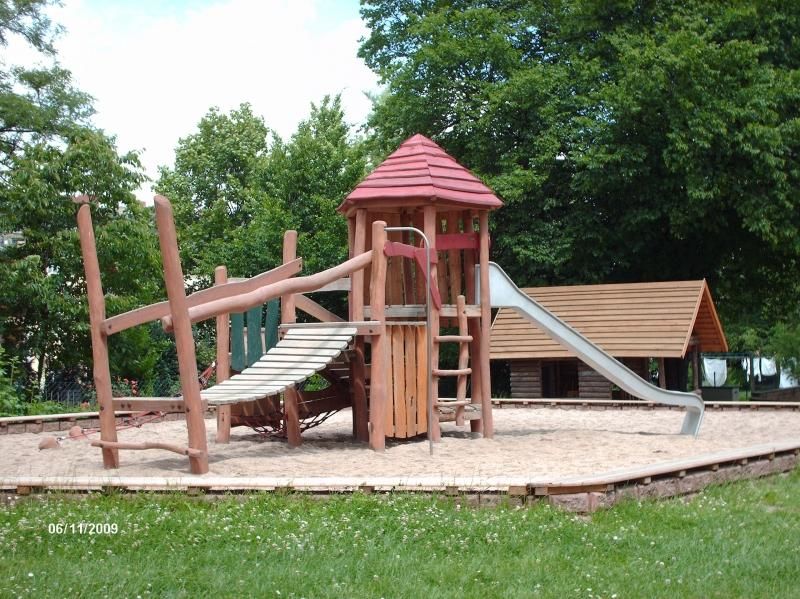
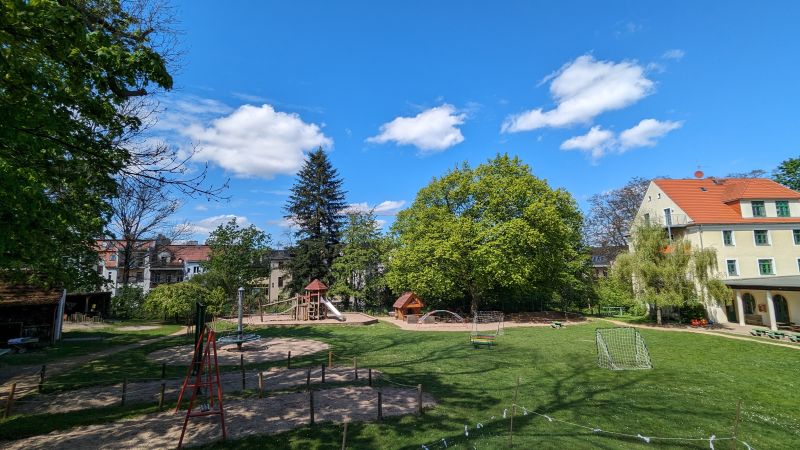
the design of rooms and the garden
-
topics and projects
-
group rules and appropriate consequences
-
visiting friends in other groups
In this way, we give children opportunities throughout the day to engage in dialogue with other children and adults, negotiate matters on an equal footing and make decisions together.
Especially in our after-school care programme, it is important to us that children are increasingly able to determine their own range of activities. For example, during children’s meetings they help decide how their leisure time in after-school care is organised. Children from the different year groups elect representatives to the Children’s Council, which is involved in important decisions concerning the organisation of our after-school care programme. In this way, the children gain their first practical experiences of democratic participation.