Kindergarten Tischardt

Address
Kindergarten Tischardt
Röntgenstraße 2
72636 Frickenhausen
Funding authority
Gemeinde Frickenhausen
Mittlere Straße 18
72636 Frickenhausen
j.tuerk@kigatischardt.frickenhausen.de
http://www.frickenhausen.de
07123/34351 (Frau Julia Türk)
Opening times7:00 AM - 4:00 PM o'clock
Closing days25
Foreign languages German
Specially educational concept daily routine language education, inclusion, infans, Situation orientated approach
Therapeutic support early advancement
Extras Barrier-free, Integrative facility, care with lunch, full day care

Current information

Introduction/specifics

Our kindergarten

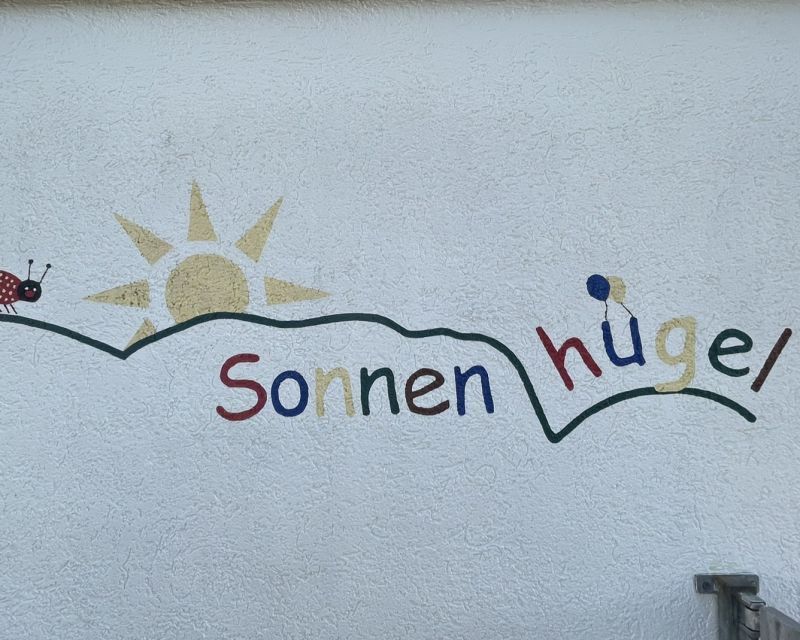
The Sonnenhügel kindergarten in Tischardt, which is part of the municipality of Frickenhausen, which is responsible for us, has existed since 1974.

It started with two kindergarten groups. There is a pure kindergarten group for 3-6 year olds with 25 places and a mixed-age group with children aged 2-6 years with 25 places (with one U3 child occupying two places).

In 2013, the crèche was added in the upper part of our building, offering space for 10 children between the ages of 1 and 3.


Rooms

When you enter our kindergarten, you will first come to our vestibule.

Here you will find our team wall where you can see who works where. You can also see current information and events in the area.

Then you come to our hall, which is used as an exercise room for all children. The groups share the use of the hall on a weekly basis. The crèche uses the hall on Wednesdays to do gymnastics with the older crèche children.

During parties or special activities, we meet with all the children in the hall to spend time together.

The hall also contains the checkroom where the children from both groups find a hook and a compartment for their belongings. Each hook is personalized with pictures and the child's name.

From the hall, we go into our two group rooms:

In the rainbow group there is a main room and a side room.In the main room you will find tables for playing and doing puzzles, a doll's corner, a second level and a small construction corner. In the side room there is a larger building corner, a painting table and a reading corner.

The sunshine group also has a main room and a side room. In the main room there are also tables for playing, kneading and doing puzzles. In the side room, the children will find a doll's corner and a large painting area.

You can also access our Yellow Salon from the hall. This is a small room with a seating area where the library and music cabinet are located. This is also where language support and small group activities take place.

From the hall, you can access our large washroom with several washbasins and toilets, a shower and a changing table.

There is also an extra toilet for adults. As well as a cleaning room.

Our kitchen is also located in the hall area. This consists of an adult and a children's area, where the children can work at child height. 

Of course, we also have cellar rooms where we can store various materials or toys to exchange. We also have an outside cellar where each group can store their materials.

Our crèche is located on the upper floor of our kindergarten.

The children have a separate checkroom here, which is personalized with pictures and names of the children, just like the kindergarten children.

The group room consists of a separate section for role-play, building blocks and vehicles, a slide, a play kitchen and a reading corner. In the remaining separate room is our kitchen, where the children can have breakfast, but also where specific activities can be carried out.

A slide leads to the activity room, which has space for romping, jumping and building with large foam blocks.

From here, we continue into the bathroom, with a changing table, a large washbasin (trough) and a toddler toilet.

Next door is our bedroom with beds for the children to sleep in.

The crèche can either go into the garden of the kindergarten or use the terrace adjoining the group room.

There is also an office on the upper floor.

This is where the management has their workplace to carry out all management functions, as well as the nursery teachers, who can spend their preparation time here or spend their break away from the children, and the room can also be used for parent meetings and the weekly team meeting.

This area is also equipped with a bathroom with WC and a washing machine and dryer.

We pay particular attention to the design of all these rooms and it is important to us that the rooms are always attractive and that the children and adults feel comfortable.

The rooms are usually decorated on a rotating basis to match the season or theme. The children often design the decorations themselves. This means they can look at them again and again and show their parents what they have made, but our rooms are also often converted. This is done according to different criteria:

* Do the children need a new play area?
* What interests the children?
* Which materials or toys can we use to further promote their development?
* Do they need more space or a different place to play with a particular material?
* Which material suits the theme?
* Which toys or which location of a play area is important for our current age group mix? If there are several smaller children, for example, they need to be able to get close to the adult.


It is also important to us, e.g. to promote independence, that the play materials are easily accessible and can be picked up and put away by the children themselves.

We also have certain rules: For example, we regulate how many children are allowed to play in the doll's corner, hall, construction corner etc. so that play is possible there at all and the children can develop. We also repeatedly point out that they should handle the toys and room equipment with care.

Our rooms are also designed to be functional, i.e. we try not to place a book corner next to a movement room, as otherwise the necessary peace and quiet and the opportunity to withdraw is no longer available.

Noise insulation is also a good way of controlling the volume that several children simply create. A curtain or carpet that also makes an area cozy immediately makes the noise more pleasant.
Outdoor Facilities

Our garden offers plenty of space:

In the garden there are several sandpits, a climbing frame, a nest swing, a slide and a climbing house. There is a climbing house especially for the U3 children, as well as extra vehicles for the smaller ones.

There is enough space for the children to move around with different vehicles. We also have two small material sheds where our sand equipment, balls, wheelbarrows, vehicles and much more are stored.


Care providers are responsible for all profile content. (State: 22/05/2026 12:43:43)

Basics

Mission statement of our kindergartens

“On the way to growing up, the children should feel supported in our facilities and we give them enough fresh wind for the eventful journey to move forward.”

Our goals:

* Promoting language skills, expanding vocabulary and the ability to express oneself
* Promote social skills, learn to live together, resolve conflicts, learn rules
* To promote integration within the group
* Promoting the individual ability of each child and valuing the child's personality
* Promoting independence, giving children freedom, encouraging them to try new things
* Promoting play, creating framework conditions, providing stimulating materials, learning through play, processing experiences
* Shaping the transition to school, leading up to school readiness
* Cooperation with the elementary school and other institutions
* Further development of educational work, teamwork, further training, public relations work
* Cooperation with parents, the parents' council, family involvement

Employee

Our team consists of pedagogical specialists and constantly changing interns. We train trainees from all years of education.

We also offer internships for pupils from secondary schools, community schools and other schools.

Additional Offerings

Language support

In the kindergartens of the municipality of Frickenhausen (in our kindergarten), additional language support for children with increased support needs takes place regularly, several days a week.

The aim of language support is to help children acquire and develop their language skills so that they can communicate, express themselves, understand each other and thus participate in the community and educational opportunities.

Both children with a migration background and German children can take part in the language support program.

Which children should take part in the language support is determined by the specialists in consultation with the parents. The results of the school examination can also be a reason for participation in language support.

Language support can only be provided with the consent of the parents. However, if the need for language support has been identified during the school examination, participation in language support is compulsory in the last year of kindergarten.

In our kindergartens (in our kindergarten), language support is provided by qualified language support staff according to the concept of the “Denkendorf Model”.

The basic principles of pre-school language support according to the Denkendorf model are:

1. Language development takes place holistically in age-appropriate play and learning situations.
2. The support takes place in small groups.
3. The support is provided in close cooperation with the educational staff.
4. Language support according to the Denkendorf model is interculturally oriented.


Inclusion

In the kindergartens of the municipality of Frickenhausen (in our kindergarten) there is a colorful diversity of families, languages, origins and individuals.

For us, it is important to take every single child seriously in their own life situation, with their own prerequisites and individual abilities. The children should be accompanied and supported in a shared day-to-day nursery and kindergarten routine so that they can learn from and with each other.

In the case of children with special needs, we work with parents and supporting institutions such as the early intervention association to see how inclusion can succeed in the facility so that children with (potential) disabilities can also experience successful participation in group activities.

In these cases, integration staff are deployed in our facilities to accompany the children on an hourly basis in everyday kindergarten life.

Quality Assurance

Quality assurance

A quality manual, a concept for the protection against violence and the concept are used to define standards that are valid for all facilities and provide binding instructions and insights for educators, the provider and parents with regard to structural and pedagogical activities.
They are constantly being developed and adapted to new requirements in order to maintain reliable conditions and meet new demands. At the same time, each facility retains its own profile.

It is important to us to present the work in the facilities in a transparent and reliable manner.

Quality manual:

https://www.frickenhausen.de/fileadmin/Dateien/Dummy/Dateien/Leben_Wohnen/Qualita%CC%88tshandbuch_2017.pdf

Protection concept:

Gewaltschutzkonzept_Kiga_Sonnenschein.pdf

Concept:

Teamwork with school

Cooperation with the Kirchert elementary school

In order to ensure a successful transition from kindergarten to elementary school for the children, there is regular cooperation with the elementary school.

In order to get to know the parents and the teacher first, a parents' evening is held in July. Here, parents are informed about the cooperation measures, the various school readiness criteria and organizational topics relating to school registration and enrolment.

From October, the teacher comes to our “school bears” (pre-school children) for one school lesson a week.

Here they are shown in a playful way what school means. Rules are discussed, foundations are laid and the first contacts are made. The teacher also assesses the children's readiness for school.

With the parents' consent, an exchange takes place between the cooperation teacher, the specialist at the facility and the parents in order to jointly find the right school for the child.

During the carnival vacations, there is a school rally in which the children can get to know the school building.

After school registration in February, further cooperation activities take place at the school, where the preschool children can get to know the classroom and the course of a lesson.

As the elementary school is right next door to us, there is contact from the very beginning of the kindergarten years. We can see directly onto the playground from our garden and can therefore always keep in touch with the former kindergarten children.

Teamwork with parents

Parenting and educational partnership

Parents and educational professionals try to coordinate their parenting styles with each other, to jointly shape, complement and support the educational process.

This is achieved through

* Admission interviews: The acclimatization of the children takes place according to the “Berlin Model”. During the settling-in period, a close relationship and a great deal of consultation between the child, parent and educator is necessary to ensure that the settling-in process is successful.
* Parent and development meetings with fixed dates
* Short door-to-door talks at drop-off and pick-up times
* Joint preparation and implementation of parties and special events
* Parents' evenings that not only provide information about kindergarten work or the kindergarten, but also topic-related parents' evenings with invited speakers
* Consultation and cooperation with the parents' councils
* Information talks, e.g. about cooperation between the kindergarten and elementary school


It is important to give parents an insight into kindergarten work - informative offers include

* Keeping portfolios
* Presentations about projects, activities, excursions, etc. on the documentation walls
* Letters to parents
* Weekly or monthly calendar with appointments


Care providers are responsible for all profile content. (State: 22/05/2026 12:43:43)

Projects

Fire safety education

Fire safety education for pre-school children takes place once a year in cooperation with the Frickenhausen volunteer fire department.

The preschoolers visit the local fire stations and learn about the following key topics:

* Dangers of fire: heat, smoke, fire gases and destruction

* Correct handling of ignition agents, necessary safety measures
* Escape routes and behavior in case of fire
* Equipment of a firefighter
* Tour of the fire engine


On a second date, there is a practice alarm in the kindergarten, in which all the kindergarten children are involved.

A practice smoke detector is triggered, the management makes an emergency call and the children gather at the assembly point. And the fire department arrives with sirens and flashing blue lights.

At the end, the pre-school children receive a certificate that reads:

“I know, I don't play with fire!”


Brushing teeth

Once a month in kindergarten, we brush the children's teeth together in our washroom. Each child has their own toothbrush and toothbrush cup with their name on it.

The crèche brushes their teeth once a week with the hand puppet “Ben”, but this only takes place in a playful way with water, as it is more about getting to know the material and how to use it.


Dental prophylaxis

The introduction to dental prophylaxis “Healthy teeth - but how?” takes place regularly for all children.

Ms. Schuster from the Esslingen Health Department introduces the children to the topic of oral hygiene in a playful way. We talk about milk teeth and permanent teeth and what is good or bad for the teeth.

Using an oversized set of teeth and an oversized toothbrush, she shows the children how to brush their teeth properly.

Using the “chewing surfaces - outer surfaces - inner surfaces” tooth brushing technique, the children practiced vigorously. Each child gets their own toothbrush and brushes their teeth together.


Dentist

Once a year, the dental practice Dr. Kotz from Frickenhausen visits us. She is responsible for us and carries out dental examinations.

This means that the children are allowed to show Dr. Kotz their teeth and he takes a quick look to see how everything looks. The parents are informed in advance by letter and give their consent with a signature that this may be carried out on their child. It is important to note that if a child does not want to, they do not have to.

Afterwards, each child is given a toothbrush cup and a toothbrush to take home.T
ranslated with.

Care providers are responsible for all profile content. (State: 22/05/2026 12:43:43)

Maps are displayed only if you accept the corresponding cookies.
enable map