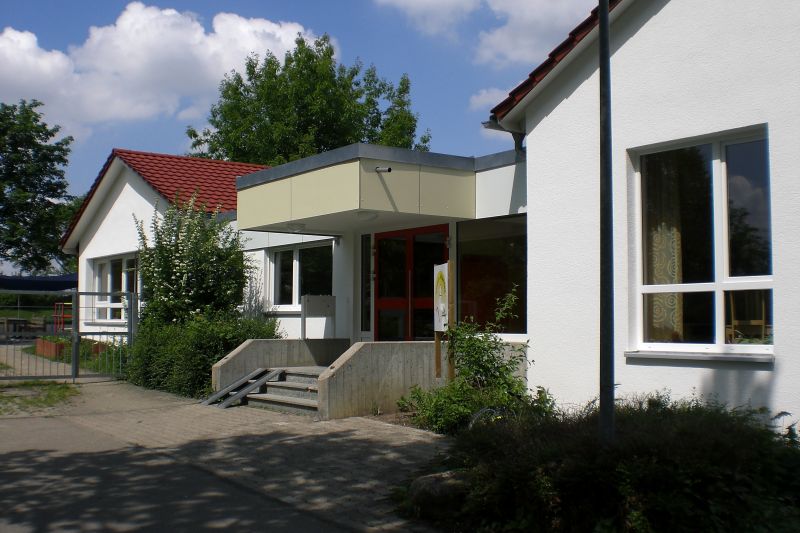
Kindergarten Auf dem Berg

2-6 Jahre

Address
Kindergarten Auf dem Berg
Fröbelstraße 4
72636 Frickenhausen
Funding authority
Gemeinde Frickenhausen
Mittlere Straße 18
72636 Frickenhausen
b.gneiting@kigaberg.frickenhausen.de
http://www.frickenhausen.de
07022/94341-700 (Bianca Gneiting)
Opening times7:00 AM - 4:00 PM o'clock
Closing days25
Extras care with lunch

Current information

Introduction/specifics

The ‘Auf dem Berg’ kindergarten has a total of five groups - three kindergarten groups and two crèche groups.

The kindergarten building houses two kindergarten groups with children aged three to six years and one group with a mixed age group of two to six years. The maximum group size varies between 25-28 children.

There are also two crèche groups in the neighbouring building, each of which can accommodate a maximum of 10 children aged 1-3 years.


In our centre, we work with fixed core groups, but the children have the opportunity to visit the other groups during free play and thus expand their experience and play environment. We also encourage contact between the children through joint activities and projects, thereby creating an open-plan environment.

Rooms

Our rooms in the kindergarten building are divided into different play areas.

In each group room, the children have a role-play and construction area, a colouring and craft corner, a reading and cuddling area as well as various table and functional games, puzzles and construction materials.

We also want to incorporate our corridor area with a ball pool and the shop into our educational work.

In order to be able to offer the children as varied a selection of games and activities as possible, the children are able to play in all of the rooms and areas of the kindergarten listed above after consultation with the specialised staff. This means that the children have the opportunity to play in the other group rooms at any time during free play.


The crèche groups also offer the children different educational and discovery areas with play areas for construction games, role play or cosy corners. There are also open spaces for playing and moving around.

In the movement room, mats, a ball pit, gymnastics equipment and other play materials encourage children to build, climb and play.

In the bedrooms, cosy sleeping areas invite children to retreat and sleep.

Outdoor Facilities

The outdoor play area for the kindergarten children consists of two gardens, each with a hard play area, meadow, sandpits, slides, swings and a playhouse. Vehicles and play equipment are also available to the children.


There is a separate garden for the crèche children, with a sandpit, playhouse, climbing and sliding facilities as well as vehicles and play equipment.


Cross-group meetings between the kindergarten and crèche groups in the different gardens take place regularly.

Daily Schedule

Our daily routine is designed to alternate between rest and movement, free play and guided activities. A regularly recurring daily routine also helps new children to familiarise themselves more quickly with the new situation and thus experience security and orientation.


The daily routine in the kindergarten groups

The children start their free play with a personal welcome for each individual child. They are free to choose where, what, how long and with whom they play. 

After tidying up together, there is a short morning circle followed by a shared snack in the group rooms. This is followed by the movement phase in the garden or various activities in the small and whole group.

At 12.00 noon, the first children are sent off, while the others continue with free play in the group room or garden.


At 1.00 pm, the children in the 2nd extended supervision period meet for lunch together. After a subsequent play phase, they are dismissed at 2.00 pm.


The afternoon kindergarten begins at 2.00 p.m. for the children in the regular day care, during which they play together in the group room or in the garden. The day ends at 4.00 pm with the closing circle.


The daily routine in the crèche groups

The day also begins for the crèche children with a personal welcome and free play. There are also activities for individual children, in the small group or the whole group.

After a shared snack, nappy-changing time follows as well as free play indoors or in the garden.


Lunch is offered at 11.00 a.m. for the children in all-day care and the 2nd extended care period. This is followed by a bedtime.


Depending on the chosen childcare time, the closing circle with the children takes place at 12.00, 12.30, 13.00 or 14.00.

For the children in all-day care, care continues with free play until 4.30 pm.

Food

In the morning, all groups have a shared snack time. Each child brings a snack from home. Fruit, vegetables, yoghurt or bread give the children energy for the day.

The children are provided with sparkling water or water to drink. They are also welcome to bring their own drinking bottles from home.


At lunch, the children are provided with freshly prepared meals from the school canteen. A varied menu with vegetable, pasta, meat or fish dishes offers the children a varied meal.

Care providers are responsible for all profile content. (State: 17/04/2025 15:43:05)

Basics

 On the way to growing up, the children in our facilities should feel supported and we give them enough fresh wind to move forward on the eventful journey.’   


Our goals:


  • Promoting language skills, expanding vocabulary and the ability to express oneself
  • Promote social skills, learn to live together, resolve conflicts, learn rules
  • To promote integration within the group
  • Promoting the individual ability of each child and valuing the child's personality
  • Promoting independence, granting freedom, encouraging children to try new things
  • Promoting play, creating framework conditions, providing stimulating materials, learning through play, processing experiences
  • Shaping the transition to school, leading up to school readiness
  • Co-operation with the primary school and other institutions
  • Further development of educational work, teamwork, further training, public relations work
  • Cooperation with parents, the parents' council, family involvement

Additional Offerings

Language support

In the kindergartens of the municipality of Frickenhausen, additional language support for children with increased support needs takes place regularly, several days a week. 

The aim of language support is to help children acquire and develop their language skills so that they can communicate, express themselves, understand each other and thus participate in the community and educational programmes.

Both children with a migration background and German children can take part in the language support programme.


Which children should take part in the language support programme is determined by the specialists in consultation with the parents. The results of the school examination can also be a reason for participation in the language support programme. 

Language support can only be provided with the consent of the parents. However, if the need for language support has been identified during the school examination, participation in language support in the last year of kindergarten is compulsory.


In our kindergartens, language support is provided by qualified language support staff according to the concept of the ‘Denkendorfer Modell’.


The basic principles of pre-school language support according to the "Denkendorfer Modell" are


  1. Language support is provided holistically in age-appropriate play and learning situations.
  2. The support takes place in small groups.
  3. The support is provided in close cooperation with the paedagogical specialists.
  4. Language support according to the Denkendorfer Modell is interculturally orientated.


Inclusion

 There is a colourful diversity of families, languages, origins and individuals in the kindergartens of the municipality of Frickenhausen.
It is important for us to take each individual child seriously and to recognise their own life situation, their own prerequisites and their individual abilities. The children should be supported and encouraged in a shared day at the crèche and kindergarten so that they can learn from and with each other.


In the case of children with special needs, we work together with parents and supporting institutions such as the Early Intervention Association to see how inclusion can succeed in the centre so that children with (potential) disabilities can also experience successful participation in group activities.

In these cases, integration staff are deployed in our centres to accompany the children on an hourly basis during their day at kindergarten.

Quality Assurance

 A quality manual, a concept for the protection against violence and the concept are used to define standards that apply to all centres and provide binding instructions and insights for teachers, the provider and parents with regard to structural and pedagogical activities.
They are constantly being developed and adapted to new requirements in order to maintain reliable conditions and meet new demands. At the same time, each centre retains its own profile.

It is important to us to present the work in the centres in a transparent and reliable manner.

Teamwork with school

In order to enable a successful transition from kindergarten to primary school for the children, there is regular co-operation with the local primary school. 


To this end, the co-operation teacher first visits the kindergarten groups to get to know the children, carry out activities and assess the children's readiness for school.  With the parents' consent, an exchange takes place between the cooperation teacher, the centre's specialists and the parents in order to jointly find the right school for the child.


At the cooperation parents' evening at the school, parents are informed about the cooperation measure, the various school readiness criteria and organisational topics relating to school registration and enrolment.


After school enrolment in February, further cooperation activities take place at the school, where the kindergarten children can get to know the school, the classroom and the course of a lesson.

Teamwork with parents

Parents and educational professionals try to harmonise their parenting styles and to jointly shape, complement and support the educational process.

This is achieved through

  • Admission interviews: The familiarisation of the children takes place according to the ‘Berlin Model’. During the familiarisation period, a close relationship and a great deal of consultation between the child, parent and teacher is necessary to ensure that the familiarisation is successful.
  • Parent and development meetings with fixed dates
  • Brief door-to-door discussions at drop-off and pick-up times
  • Joint preparation and organisation of parties and special events
  • Parents‘ evenings that not only provide information about kindergarten work or the kindergarten, but also themed parents’ evenings with invited speakers
  • Consultation and cooperation with the parents' councils
  • Informational talks, e.g. about co-operation between the kindergarten and primary school


It is important to give parents an insight into kindergarten work - informative offers include

  • Keeping portfolios
  • Presentations about projects, activities, excursions, etc. on the documentation walls
  • Letters to parents
  • Weekly or monthly calendars with appointments 
Care providers are responsible for all profile content. (State: 17/04/2025 15:43:05)

Projects

Dental prophylaxis

The introduction to dental prophylaxis ‘Healthy teeth - but how?’ takes place regularly for all children.

An employee from the Esslingen Health Department introduces the children to the topic of oral hygiene in a playful way. We talk about milk teeth and permanent teeth and what is good or bad for the teeth.

Using an oversized set of teeth and an oversized toothbrush, she shows the children how to brush their teeth properly.


Using the ‘chewing surfaces - outer surfaces - inner surfaces’ tooth brushing technique, the children practised vigorously. Each child is given their own toothbrush and brushes their teeth together.


Fire safety education

Once a year, fire safety education is organised for pre-school children in cooperation with the Frickenhausen volunteer fire brigade.

The preschoolers visit the local fire stations and learn about the following key topics:


  • Dangers of fire: heat, smoke, fire gases and destruction
  • Correct handling of ignition agents, necessary safety measures
  • Escape routes and behaviour in the event of fire
  • Equipment of a firefighter
  • Tour of the fire engine

On a second date, there is a practice alarm in the kindergarten in which all the children of the kindergarten are involved.


A practice smoke alarm is triggered, the management makes an emergency call and the children gather at the assembly point. And the fire brigade arrives with sirens and flashing blue lights.

At the end, the pre-school children receive a certificate that reads:


‘I know, I don't play with fire!’

Care providers are responsible for all profile content. (State: 17/04/2025 15:43:05)

Maps are displayed only if you accept the corresponding cookies.
enable map