
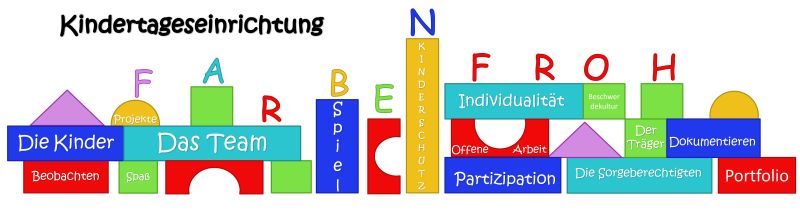
Kita "Farbenfroh"

2 Jahre bis Schuleintritt

Address
Kita "Farbenfroh"
Hintergasse 11
35690 Dillenburg
Funding authority
Oranienstadt Dillenburg
Rathausstraße 7
35683 Dillenburg
kindergarten-nanzenbach@dillenburg.de
02771/33244 (Frau Nöcker)
Opening times7:30 AM - 4:00 PM o'clock
Specially educational concept daily routine language education, open concept, Situation orientated approach
Extras Integrative facility, care with lunch, full day care

Current information

Our daycare center closes at 2:00 PM on Fridays!

Introduction/specifics

The daycare center "Farbenfroh" offers education and care for up to 50 children from the age of 2 until they start school. The well-being of the child is at the center of our work. The foundation is the Hessian Education and Training Plan (2007), which focuses on the individual support of each child. Our goal is to strengthen children's autonomy and promote social responsibility. To this end, we provide the children with various learning spaces in an open-concept setting. More information can be found on the website of the town of Dillenburg. https://www.kinderbetreuung-dillenburg.de/


Learning Spaces for Children in an Open Concept

In our facility, there are various educational areas that are open to children for self-directed use during free play time. We place great importance on allowing children to explore and discover according to their interests and needs. The design of the educational areas is guided by the children's impulses and life experiences. This has already led to the creation of creative play spaces, such as a post office, a castle, a horse stable, or a doctor's practice, among others.Learning Spaces for Children in an Open Concept




Rooms

In the creative area, children have access to a variety of materials and colors for independent creative activities.

The construction area provides space for independently building a wide range of structures.

For this purpose, different building materials are available. In our movement room, various movement landscapes or movement construction sites are planned and set up.

In our reading oasis, there are various books to look at, explore, or even participate with.

The children can enjoy their breakfast together with their friends at a nice breakfast counter.

Daily Schedule

Daily Schedule

7:30 – 9:00 AM                 Drop-off time for children Arrival                                                                                                                                                   Greeting the child in the group

7:30 – 11:00 AM               Free play time                                        

                                         Children can engage in the different learning areas

11:00 AM – 12:00 PM       Division into age-homogeneous groups                                        

                                         This is when projects/activities/circle time take place

12:00 – 1:00 PM               Lunch                                        

                                         Lunch for full-day children

12:00 – 4:00 PM              Pick-up time – handover to authorized persons                                        

                                        Based on the booked modules

2:00 – 3:00 PM                Activity/ free play                                        

                                        Based on the interests of the children

3:00 PM – 3:30 PM         Afternoon Snack

                                       Small snack that is prepared and eaten together

4:00 PM                         Daycare closes

Care providers are responsible for all profile content. (State: 15/06/2026 11:19:54)

Basics

Shaping Transitions A special focus is on careful acclimatization, which represents the first important step into the new environment, as well as on the transition to school, which is also accompanied with sensitivity. For a successful acclimatization, a trusting relationship between professionals, parents, and the child is important. A successful transition is ultimately reflected in the child exploring their environment and expressing their well-being, for example through positive emotions.

The settling-in process with us is based on the Berlin acclimatization concept. In this process, the child's key caregiver individually supports the child and follows their personal pace and needs.

Since we see children as active and competent co-creators of their settling-in process, we have expanded the process in 2024 to include the participatory approach of "peer-group" acclimatization (Tübingen model). Unlike the Berlin model, this approach takes place in a small group of children of the same age.

Age-homogeneous Group Time

Lions (2-3 years)
In regular circle times, various topics are playfully addressed, e.g., finger games, circle games, and songs. This helps strengthen understanding of rules, patience, waiting, and concentration.

Ducks (4-5 years)
In addition to daily activities for the duck children, they visit Duckland (Professor Dr. Gerhard Preiß) once a week. The focus here is to experience mathematical education in an engaging way. The children explore colors, shapes, numbers, sorting, ordering, and spatial orientation through play. An important aspect of Duckland is, among other things, learning in a community setting. (Preiß, 2025)

Maxis (Preschool Children)

Our Maxis experience their final year in the daycare center with lots of excitement, surprises, excursions, and embark on a pirate journey.

Through a symbolic 'pirate journey,' the children experience different adventures each week, overcome challenges, and discover their own abilities, as preparation for new stages in life.

Care providers are responsible for all profile content. (State: 15/06/2026 11:19:54)

Maps are displayed only if you accept the corresponding cookies.
enable map