Kinderhaus Papperlapapp

1 bis 3 Jahre

Address
Kinderhaus Papperlapapp
Dorfstraße 20
88285 Bodnegg
Funding authority
Johanniter-Unfall-Hilfe e.V. Regionalverband Oberschwaben / Bodensee
Pfannenstiel 31
88214 Ravensburg
kinderhaus.papperlapapp@johanniter.de
http://www.johanniter.de/papperlapapp-bodnegg
07520 920717
Opening times7:00 AM - 4:00 PM o'clock
Closing days14 Schließtage + 4 pädagogische Tage + 2 Putztage= 20 Tage
Specially educational concept daily routine language education, open concept, Situation orientated approach
Extras Barrier-free, care with lunch, full day care

Current information

Introduction/specifics

Care Hours/Modules Three-day group: Monday – Wednesday, 7:00 a.m. – 12:30 p.m. (includes lunch) Half-day group: Monday – Friday, 7:00 a.m. – 12:30 p.m. (includes lunch) Full-day group: Monday – Friday, 7:00 a.m. – 2:30 p.m. (includes lunch and nap/rest period) Monday – Friday, 7:00 a.m. – 4:00 p.m. (includes lunch, nap/rest period, and afternoon snack) Attitude of the Educational Staff The educational staff at Kinderhaus Papperlapapp place great importance on treating one another with respect and appreciation. Our approach is shaped by a Christian view of humanity. Through designated "departments" or areas of responsibility, each staff member can contribute their personality, individual skills, and life and professional experiences, thereby enriching the Kinderhaus concept with their knowledge. An inclusive mindset is a matter of course for the entire Kinderhaus team. We welcome everyone with their unique characteristics and always seek individual, respectful solutions through collaborative cooperation. All relationships are shaped by this appreciative, resource-oriented attitude. In our daily interactions, this attitude serves as a model for the children. It also runs as a common thread through our collaboration with parents.
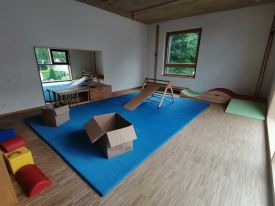
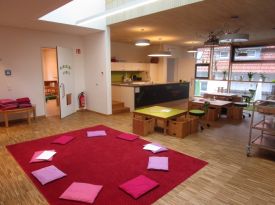
Rooms

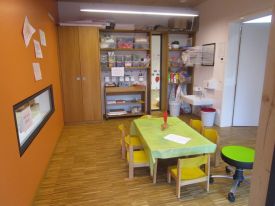
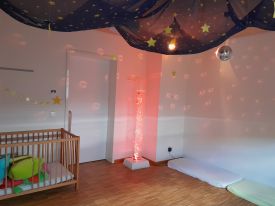
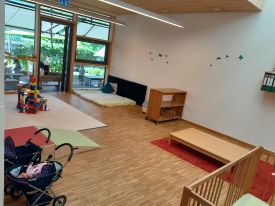
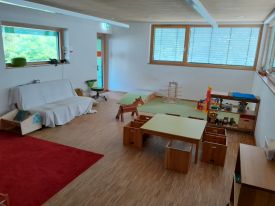
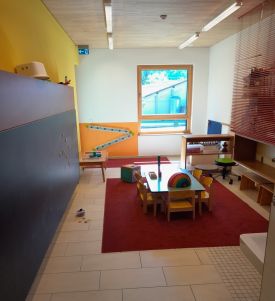
The individual rooms within the children's center play a vital role and form the foundation of its educational approach. The spatial design consistently offers children the opportunity to gain important educational experiences independently. At the Papperlapapp children's center, education is viewed as a lifelong process. The entire facility was specifically designed to meet the needs of children aged one to three, ensuring the best possible support for their development. Children under the age of three are already capable of performing many everyday tasks independently; consequently, play materials throughout the center are always placed at the children's eye level. The architecture and furnishings are also designed to allow children to experience and practice their independence in a variety of ways.

Outdoor Facilities

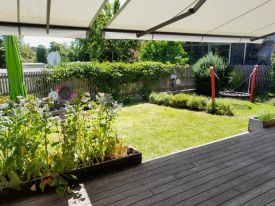
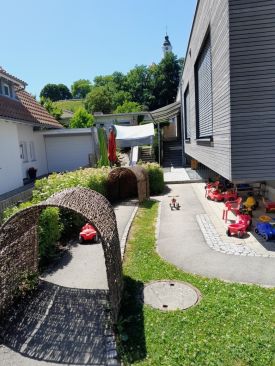
The garden is a space where children can gain important motor skills and valuable experiences with nature.

Care providers are responsible for all profile content. (State: 05/10/2026 15:13:04)

Basics

Guiding Principle Alongside the religious-educational profile of Johanniter-Unfall-Hilfe e.V. and the Baden-Württemberg educational framework (*Orientierungsplan*), this guiding principle forms the foundation of our daily work. We support and encourage each child to find their place in the community through an attitude characterized by appreciation, respect, openness, honesty, and positivity. Within the group, every child has the opportunity to experience themselves through interactions with others. They learn about the needs of others—which may differ from their own—and encounter boundaries, whether their own, those of others, or those set by their environment. In spaces designed specifically to meet their needs, children can pursue their curiosity and their urge to discover themselves and the world around them. This creates countless opportunities to foster the development of the senses, the body, language, cognition, emotions, values, and religious understanding. In doing so, each child can proceed at their own pace and tailor their experiences to their current needs. Building Relationships It is now well-established that, alongside hereditary factors, environmental influences play a decisive role in human development. Within a suitably prepared environment—and through loving, sensitive relationships—a child can develop into a competent adult while feeling safe and secure. The younger the child, the closer and more intensive this relationship should be. Consequently, building relationships is a top priority in the daily work of our educational staff.

Teamwork with parents

The team at the children's center places great importance on effective and in-depth collaboration with parents. Beyond a foundation of mutual understanding and acceptance between parents and educational staff, close cooperation and open communication are essential for high-quality care. Just as the staff are experts in early childhood education and development, parents are viewed as experts on their own children. It is important to the team that parents feel confident their child is in good hands at Kinderhaus Papperlapapp. We are always ready to listen to any concerns. All suggestions, requests, worries, or complaints are addressed according to a structured process and, whenever possible, resolved to the satisfaction of all parties involved.

Specifics

Marte Meo
Marte Meo was developed by Maria Arts, who is from the Netherlands. The term comes from Latin and translates to "by one's own strength." This method focuses on recognizing and highlighting the child's strengths. Friendly facial expressions and a warm tone help foster positive relationships. By naming emotions and providing words for the children's actions, we help them learn to perceive themselves and others while expanding their vocabulary. The children gain the experience of being seen and feeling like part of a community. At the children's center, we apply Marte Meo in all everyday situations—such as during the settling-in period, free play, getting dressed and undressed, and so on. Through this approach, children acquire social skills, learn to recognize and understand the play worlds of others, and develop empathy and an understanding of their environment. Their self-confidence is strengthened as they learn to identify and name their own emotions, enabling them to recognize their own boundaries as well as those of others.

Care providers are responsible for all profile content. (State: 05/10/2026 15:13:04)

Maps are displayed only if you accept the corresponding cookies.
enable map