Kindergarten Sonnenschein

3-6

Address
Kindergarten Sonnenschein
Ob. Schloßstraße 70
73553 Alfdorf
Funding authority
Gemeinde Alfdorf
Obere Schlossstraße 28
73553 Alfdorf
Opening times7:00 AM - 2:00 PM o'clock
Closing days30
Specially educational concept project approach, Situation orientated approach
Extras cooperation facility

Current information

Since 2001, the "Sonnenschein" Kindergarten has been a kindergarten run by the municipality of Alfdorf. You can find us in an idyllic neighborhood right next to the Schlossgartenschule in Alfdorf.

Over the past few years, we have continuously evolved. Our educational and spatial concept is constantly adapted to current needs, statutory guidelines, and modern regulations to provide children with the best environment in which to grow.

Care hours for families We currently offer a total of 70 spaces. You have the option to flexibly adapt the care hours to your daily routine:

  • VÖ 6: 07:00 AM – 01:00 PM

  • VÖ 7 (for working parents): 07:00 AM – 02:00 PM

Regular weekly highlights A varied everyday routine is important to us! The children can look forward to the following every week:

  • Gymnastics together: Play, fun, and movement

  • Forest and meadow day: Experiencing and discovering nature up close

  • Sprachfit: Playful language support for the school starters ("Schulhüpfer")

  • Diverse projects based on the annual plan

  • Cooperations: Close collaboration with the Schlossgartenschule, Anja Kommode, the Janusz Korczak School, as well as the kindergartens of the municipality of Alfdorf

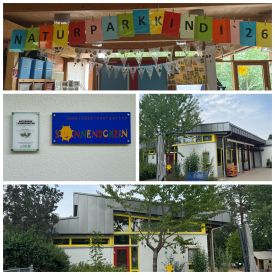
Since 2026, we have been a Nature Park Kindergarten. As a Nature Park Kindergarten, we spend a lot of time on projects about nature and use it as a diverse educational space. Through joint discovery, research, and experiences, we promote a connection to nature, movement, social skills, and mindful interaction with our environment.

Introduction/specifics

Our Nature Park Kindergarten provides places for a total of 70 children between the ages of 3 and 6. The children are cared for in three groups: the Sun Group, the Little Sun Group and the Rainbow Group.

Our Team

Our educational work is supported by eight experienced early childhood educators, as well as our dedicated inclusion support staff.

The kindergarten is managed by Sonja Indof.

Activities Throughout the Kindergarten Year

Throughout the kindergarten year, we offer a varied and diverse programme that supports the children’s development while ensuring that they have fun and enjoy learning and discovering new things.

Our programme includes:

  • As a certified Nature Park Kindergarten, we offer exciting projects and activities based on the seasons and the natural environment.

  • We incorporate special features and local attractions of our beautiful community, which is located within the Swabian-Franconian Forest Nature Park, into our educational activities.

  • Projects such as “From Grain to Bread”, forest projects and many other nature-related activities.

  • Regular forest days, as well as a forest week once a year.

  • Physical education and sports sessions in the “Alte Halle” sports hall.

  • Activities as part of the “Gesundes Boot” (“Healthy Boat”) programme, for which our kindergarten has received an award.

  • Toy and cuddly toy days, when children are allowed to bring a favourite toy or cuddly toy from home.

  • Portfolio work to document and reflect on each child’s individual development.

  • Road safety training for preschool children in cooperation with the traffic police.

  • The “Abenteuer Helfen” (“Helping Adventure”) course for our older children.

  • Activities focusing on dental health and oral hygiene.

  • Cooperation with Schlossgarten School.

  • Cooperation with the Heldenreich Occupational Therapy Practice.

  • The “Sprachfit” language development programme for preschool children.

  • And much more!

Rooms

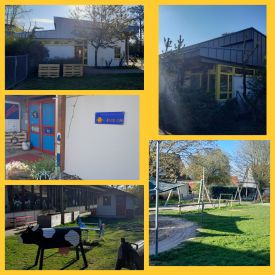
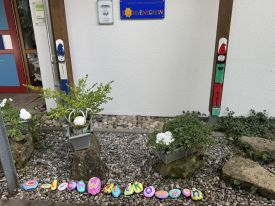
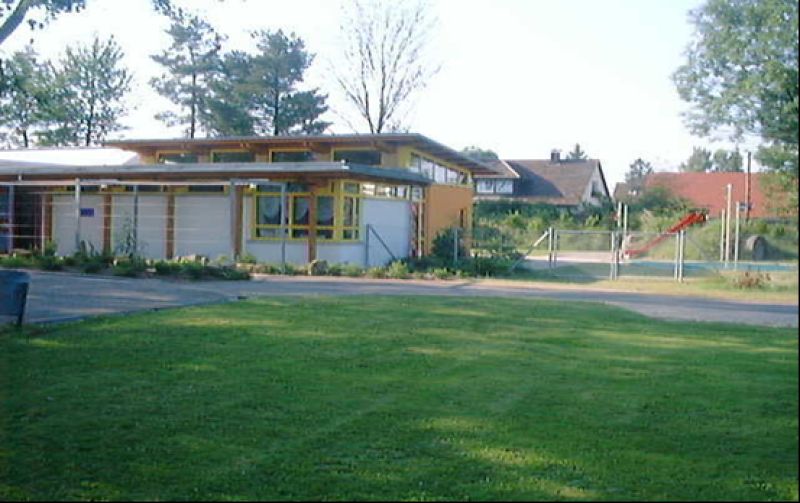
Kindergarten Sonnenschein is located directly next to Schlossgarten School.

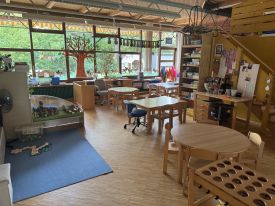
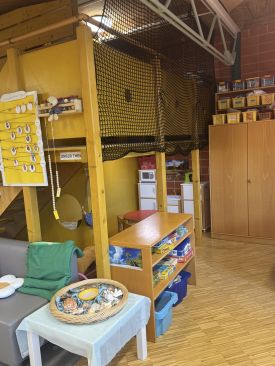
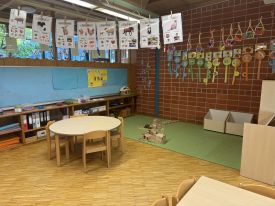
The group rooms are former classrooms. Two of the group rooms have been enhanced with a second level and have been individually designed by the groups. The design is based on the children’s needs and interests, which is why the layout of the rooms is regularly changed.

The group room gives children the opportunity to relax, withdraw, and interact and engage in activities with other children. For children, the group room also serves as a means of orientation: every object has its place within a larger structure and order.

Kitchen

Our kitchen provides children with the opportunity to participate in cooking and baking activities. They are at eye level with the adults and can actively help with the preparations. Depending on the theme and the season, we cook or bake something related to each of our educational topics.

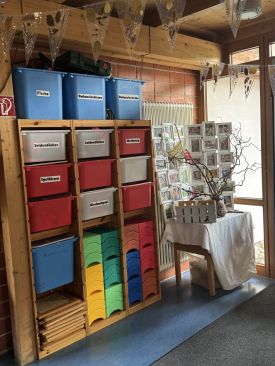
Activity and Movement Area in the Foyer

Additional Rooms

Our additional rooms are used by all groups.

The additional rooms are also used for:

  • Small-group activities, such as looking at picture books or activities with the older children

  • Free play, e.g. listening to CDs

  • Early intervention services and parent-teacher meetings

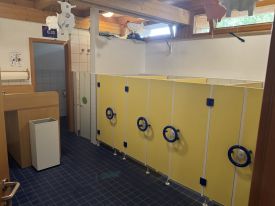
Children’s Toilets

The children’s toilets are shared and used by all the children from the different groups.

There are also:

  • An office for the management and staff

  • A cleaning/storage room, which is locked and not accessible to the children

  • A sanitary area with changing facilities

  • One small additional room

  • One large additional room with a materials storage area

  • And, last but not least, our large garden with a wide variety of play opportunities

Outdoor Facilities

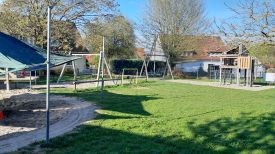
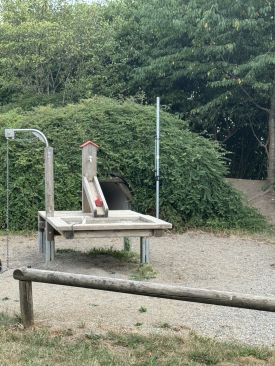
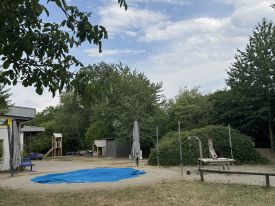
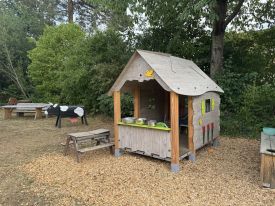
Our large garden offers the children many opportunities to play, explore and be active outdoors.

We have two climbing frames, a large sandbox, a water play area during the summer, two swings and a nest swing, a mud kitchen, a playhouse and a wide variety of ride-on vehicles.

There is also plenty of space for playing football, drawing with chalk and enjoying many other outdoor activities.

We also have three raised garden beds, where we grow seasonal vegetables, herbs and fruit throughout the year. The children can actively participate in planting, caring for and harvesting the plants and experience how food grows.

Daily Schedule

Daily Routine at the Kindergarten

The kindergarten opens at 7:00 a.m. The children arrive at the kindergarten by 8:30 a.m. at the latest.

Welcome

Free Play

Free play is very important for the children! They are free to choose the play materials, their play partners, the place where they want to play, and how long they want to play.

This promotes the child’s independence. Children are responsible for the play materials; they are encouraged to handle them carefully and to put them away again after playing.

Children also practice social skills during free play. They gain experience in interacting with others, learn how to resolve conflicts, and develop solutions together.

Free play is not only important for the children, but also for us as educators. We observe the children and learn where they may have difficulties and where they need help and encouragement. In this way, we can best support and promote each child’s individual stage of development. Social contacts also develop particularly well during this time.

During free play, the educator can spend more time with individual children and support the development of their language skills, concentration and persistence, dexterity, and other abilities that cannot always be addressed during activities with the whole group.

The educator acts as a play partner, guides and supports the children, but also steps back and observes whenever possible. Free play has an important place in our daily routine and requires careful attention and support. It provides children with a wide range of opportunities to explore and develop different skills and abilities.

Free-Play Activities

Free-play activities, such as painting windows, arts and crafts, creative activities, or working with different materials, are designed to encourage children to participate voluntarily and on their own initiative. They are intended to help children become interested in new and unfamiliar things.

We accompany the children by giving them our attention, playing with them and being present, as well as supporting and helping them when needed.

After free play, we clean up together. We then have a meal together.

Afterwards, depending on the daily schedule, there are different activities, such as sitting together in a circle, playing various games as a group, listening to stories, going into the garden, or taking part in a planned activity.

Circle Time

Circle time is very important for the sense of community. Through the enjoyment of playing games together, the group grows closer and develops a stronger sense of togetherness.

Children’s conferences also take place during circle time.

“Children’s conferences are discussion groups that give children and adults the opportunity to address and respond to different needs and requirements that arise from living and working together.”

For example, children can participate in deciding on new topics for our educational plans or contribute ideas for how these topics can be implemented. Group decisions are also discussed and considered together.

During our daily circle time, the children experience a sense of community. They learn to consider others, wait their turn, and contribute their own ideas. They develop their ability to concentrate for a certain period of time and actively participate in what is happening.

During circle time, we sing, talk, dance, play, and celebrate together. Recurring rituals are particularly important for children. Repetition also plays a major role. Children often ask to play the same circle games over and over again because, as part of their development, they rely on familiarity and recognition.

Circle time also gives children the opportunity to be the center of attention at times and to learn to be confident and try new things.

Planned Activities

Some activities cannot be carried out with the whole group. These activities are therefore offered in small groups during free-play time.

Examples include:

  • Looking at and discussing picture books

  • Physical activities and gymnastics

  • Introducing and learning new songs

  • Conducting experiments

  • Discussions about specific topics

  • Looking at and discussing works of art

  • Activities specifically designed for older children

  • And much more

The following applies to all planned activities: The main focus is on helping children concentrate for a limited period of time and learn to postpone their own wishes and needs.

Such activities take place with the whole group, in small groups, or as individual support and learning activities.

Care providers are responsible for all profile content. (State: 29/10/2026 13:46:38)

Projects

Every year, we choose an annual theme that accompanies us throughout the entire kindergarten year. Based on this theme, we develop individual projects that we explore with the children over several weeks.

This year, our annual theme is:

“Our Nature Park – Our Home”

This theme offers us many opportunities to explore different educational areas and becomes an integral part of our everyday activities. Through hands-on experiences, projects, discussions and activities, the children can discover and learn more about nature, their environment and the place they call home.

The theme allows us to connect different areas of learning in a meaningful and engaging way while encouraging the children’s curiosity, creativity and appreciation for their natural surroundings.

Care providers are responsible for all profile content. (State: 29/10/2026 13:46:38)

Maps are displayed only if you accept the corresponding cookies.
enable map